
Air Conditioning
Reliable, high-efficiency cooling solutions for Bay Area homes
How Air Conditioners Work
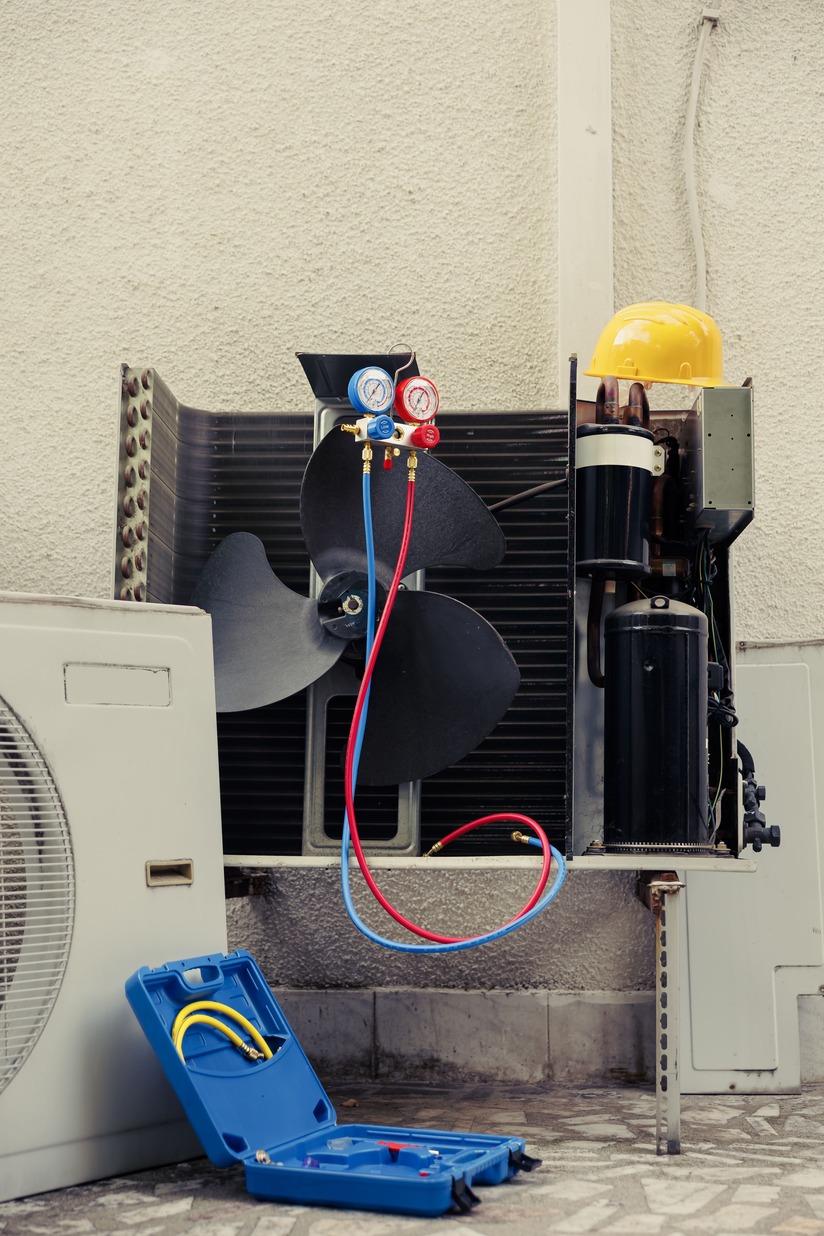
Air conditioners do not actually create cold air. Instead, they remove heat and moisture from the indoor environment and transfer it outside. This process relies on the refrigeration cycle, the same fundamental principle that keeps your refrigerator cold. Understanding how your AC works helps you make informed decisions about maintenance, repairs, and upgrades.
The refrigeration cycle is a continuous loop in which a chemical refrigerant absorbs heat energy inside your home and releases it outdoors. The refrigerant changes between liquid and gas states as it circulates, enabling it to carry large amounts of thermal energy efficiently. Here is how each major component plays its role:
The Evaporator Coil
Located inside your home, typically within the air handler or attached to the furnace, the evaporator coil is where cooling actually happens. Warm indoor air is drawn across the coil by the blower fan. The refrigerant inside the coil is in a cold, low-pressure liquid-gas state, and it absorbs heat from the passing air. As it does so, the refrigerant evaporates into a gas. The newly cooled air is then distributed throughout your home via the ductwork. Moisture in the air condenses on the cold coil surface, which is how your AC also acts as a dehumidifier.
The Compressor
Often called the heart of the air conditioning system, the compressor is housed in the outdoor condensing unit. After the refrigerant absorbs heat at the evaporator coil, it travels to the compressor as a warm, low-pressure gas. The compressor squeezes this gas into a hot, high-pressure state, which raises its temperature well above the outdoor air temperature. This pressure increase is essential because heat naturally flows from hotter areas to cooler ones, and the refrigerant must be hotter than the outside air to release its stored heat. Modern systems use scroll compressors or variable-speed inverter compressors for improved efficiency and quieter operation.
The Condenser Coil
Also located in the outdoor unit, the condenser coil performs the opposite function of the evaporator coil. The hot, high-pressure refrigerant gas flows through the condenser coil while a large fan blows outdoor air across it. Because the refrigerant is hotter than the outside air, heat transfers from the refrigerant to the outdoor air. As the refrigerant loses heat, it condenses back into a warm, high-pressure liquid. This is the step where the heat absorbed from inside your home is actually expelled outdoors.
The Expansion Valve
Before the refrigerant returns to the evaporator coil, it must be cooled back down. The expansion valve (also called a metering device or thermostatic expansion valve) creates a restriction that causes a rapid drop in refrigerant pressure. When pressure drops, so does temperature. The refrigerant becomes a cold, low-pressure liquid-gas mixture, ready to absorb heat all over again as it enters the evaporator coil. Newer systems use electronic expansion valves (EEVs) that can precisely regulate refrigerant flow for optimal performance across a range of conditions.
This cycle repeats continuously while the system is running, steadily drawing heat out of your home and releasing it outdoors until the thermostat’s set temperature is reached.
Benefits of Modern Air Conditioning
Today’s air conditioning systems go far beyond simple cooling. They deliver comfort, health, and efficiency in ways that older units never could.
Reliable, Consistent Cooling
Modern air conditioning systems provide even, consistent cooling throughout your home. Variable-speed compressors and multi-stage operation allow the system to precisely match cooling output to your home’s needs, eliminating the uncomfortable hot-and-cold swings that older single-stage systems produce. With properly designed ductwork and a correctly sized unit, every room in your home stays at the temperature you choose.
Humidity Control
The Bay Area experiences periods of uncomfortable humidity, especially during late summer and early fall. Air conditioners naturally dehumidify as they cool, since moisture condenses on the cold evaporator coil and drains away. By reducing indoor humidity to the 30-50% range, your home feels more comfortable even at slightly higher thermostat settings. Proper humidity control also protects wood floors, furniture, and musical instruments from moisture damage, and discourages mold and dust mite growth.
Improved Indoor Air Quality
Every time air passes through your AC system, it moves through a filter that captures dust, pollen, pet dander, and other airborne particles. Higher-rated MERV filters can trap even smaller pollutants like mold spores and bacteria. Because a well-functioning AC system keeps windows closed and maintains positive indoor pressure, it also reduces the infiltration of outdoor pollutants, wildfire smoke, and allergens, something particularly valuable during Bay Area fire season.
Modern Energy Efficiency
Air conditioning technology has advanced dramatically. Today’s high-efficiency systems use 30-50% less energy than units manufactured just 10-15 years ago. Features like inverter-driven compressors, electronically commutated motors (ECM blowers), and smart thermostat integration allow modern ACs to consume only the energy they need at any given moment. This translates directly to lower utility bills and a reduced carbon footprint, without sacrificing comfort.
Enhanced Home Value
A modern, efficient air conditioning system is a strong selling point for Bay Area homes. Buyers look for homes with updated HVAC systems because it means years of reliable comfort without needing immediate replacement. High-efficiency equipment with strong SEER ratings can also qualify your home for green certifications and energy-efficiency labels that boost market appeal.
Quieter Operation
Older air conditioners were often loud enough to disturb conversations and sleep. Modern systems incorporate sound-dampening compressor mounts, insulated cabinets, variable-speed fans, and redesigned blade geometries that drastically reduce noise. Many current models operate at sound levels below 55 decibels outdoors, which is quieter than a normal conversation. Indoor noise levels are even lower, letting you enjoy cool comfort in peace.
Understanding SEER Ratings
SEER stands for Seasonal Energy Efficiency Ratio. It is the standard measure of air conditioning efficiency in the United States and is determined by dividing the total cooling output (measured in BTUs) over a typical cooling season by the total electricity consumed (in watt-hours) during that same period. A higher SEER number means greater efficiency and lower operating costs.
How SEER Is Calculated
Unlike a simple efficiency snapshot, SEER accounts for performance across a range of outdoor temperatures from 65 to 104 degrees Fahrenheit, simulating real-world seasonal conditions. This makes it a more accurate representation of what you will experience over an entire summer than a single-point rating would be.
SEER2: The Updated Standard
As of January 2023, the Department of Energy transitioned to SEER2, an updated testing procedure that uses higher external static pressure to better simulate real-world duct conditions. SEER2 numbers are typically slightly lower than SEER numbers for the same unit. The new federal minimum for residential air conditioners in the Southwest region (which includes California) is 15 SEER2 (approximately 15.2 SEER under the old standard).
What the Numbers Mean for Your Wallet
To illustrate the impact of efficiency ratings, consider a typical Bay Area home that requires about 18,000 BTU/h of cooling capacity. Upgrading from an older 10 SEER unit to a modern 20 SEER unit cuts your cooling electricity consumption roughly in half. For a household spending $800 per year on cooling, that is an annual savings of approximately $400. Over the 15-20 year lifespan of a quality AC system, those savings add up substantially.
Choosing the Right SEER for Your Home
Higher SEER units have higher upfront costs, so there is a point of diminishing returns depending on your climate, usage patterns, and local energy prices. For most Bay Area homes, a system in the 16-20 SEER range provides an excellent balance of performance and value. Homes with very high cooling demands or owners planning to stay long-term may benefit from investing in 20+ SEER premium equipment. Our team will perform a detailed load calculation and cost analysis to help you find the sweet spot.
Minimum
15 SEER2
Federal minimum for California as of 2023. A solid baseline for budget-conscious homeowners. Significantly more efficient than older units rated 8-10 SEER.
Minimum
16-20 SEER
The best balance of efficiency and value for most Bay Area homes. Features like two-stage compressors and variable-speed fans deliver consistent comfort and strong energy savings.
Premium
20+ SEER
Top-tier efficiency using inverter-driven variable-speed compressors. Ideal for high-use homes and maximum long-term savings. Whisper-quiet operation and exceptional humidity control.
Types of Air Conditioning Systems
There are several types of air conditioning systems, each with distinct advantages. The best choice depends on your home’s layout, existing infrastructure, and cooling needs.
Central Air Conditioning
Central AC is the most common whole-home cooling solution. It uses an outdoor condensing unit connected to an indoor evaporator coil (typically installed on top of a furnace or inside an air handler). Cooled air is distributed through your home’s ductwork to every room.
Best for: Homes with existing ductwork that need whole-house cooling. Central AC provides uniform temperatures throughout the home and pairs seamlessly with a furnace for year-round heating and cooling.
Pros: Even whole-home cooling, powerful dehumidification, high capacity, wide range of efficiency options (15 SEER2 to 26+ SEER), relatively quiet indoor operation, works with zoning systems for room-by-room control.
Cons: Requires ductwork (installation can be costly if none exists), duct leaks can reduce efficiency by 20-30%, outdoor unit requires clearance space, single-point efficiency loss if ducts are poorly sealed.
Ductless Mini-Split Systems
Ductless mini-splits consist of an outdoor compressor/condenser unit connected by refrigerant lines to one or more indoor air-handling units mounted on walls or ceilings. Each indoor unit cools its own zone independently, and no ductwork is needed.
Best for: Homes without ductwork, room additions, converted garages, home offices, or any space where running new ducts is impractical. Also excellent for supplemental cooling in problem areas that the central system cannot reach effectively.
Pros: No ductwork required (eliminates duct losses), zone-by-zone temperature control, extremely energy efficient (many models exceed 20 SEER), very quiet operation, compact outdoor units, flexible installation options, inverter compressors for precise comfort.
Cons: Higher cost per ton of cooling than central AC, indoor units are visible on walls, each indoor unit requires a small hole through the exterior wall, may need multiple outdoor units for large homes, requires specialized installation by trained technicians.
Window & Portable Units
Window units are self-contained air conditioners that fit into a window opening, with the evaporator side facing indoors and the condenser side facing outdoors. Portable units sit on the floor inside the room and exhaust hot air through a hose connected to a window kit.
Best for: Temporary cooling needs, rental properties where permanent installation is not allowed, or very small spaces where other options are not feasible. These are generally considered a stopgap rather than a long-term solution.
Pros: Low upfront cost, no professional installation required, can be removed and relocated easily, no permanent modification to the home.
Cons: Low efficiency (most are 10-12 EER), noisy operation, only cools one room at a time, blocks the window, uneven cooling, poor humidity control compared to whole-house systems, higher long-term operating costs, limited capacity, no integration with home thermostats.
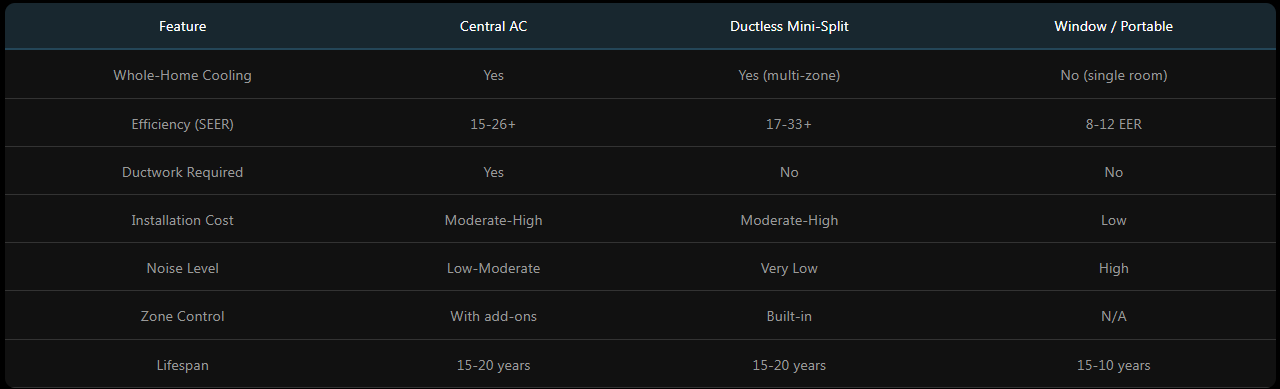
System Comparison at a Glance
| Feature | Central AC | Ductless Mini-Split | Window / Portable |
|---|---|---|---|
| Whole-Home Cooling | Yes | Yes (multi-zone) | No (single room) |
| Efficiency (SEER) | 15-26+ | 17-33+ | 8-12 EER |
| Ductwork Required | Yes | No | No |
| Installation Cost | Moderate-High | Moderate-High | Low |
| Noise Level | Low-Moderate | Very Low | High |
| Zone Control | With add-ons | Built-in | N/A |
| Lifespan | 15-20 years | 15-20 years | 15-10 years |
Signs You Need AC Repair or Replacement
Catching problems early can save you from costly breakdowns during the hottest days of summer. Here are the warning signs to watch for.
Signs Your AC Needs Repair
These symptoms usually indicate that a professional repair can restore your system to proper function:
-
Warm air blowing from vents: If the air from your vents is not cold, the refrigerant charge may be low, the compressor may be struggling, or the evaporator coil may be frozen. All of these are repairable issues. -
Weak or reduced airflow: Clogged filters, blocked ducts, a failing blower motor, or a frozen evaporator coil can all restrict airflow. A technician can diagnose and fix the root cause. -
Unusual noises: Grinding, squealing, rattling, or banging sounds from either the indoor or outdoor unit typically indicate a loose part, worn bearing, failing motor, or debris in the system. These should be addressed before they cause further damage. -
Frequent cycling: If the system turns on and off rapidly (short cycling), it may be oversized, have a refrigerant leak, an electrical issue, or a faulty thermostat. Short cycling stresses components and drives up energy costs. -
Water leaks around the unit: Condensation is normal, but pooling water near the indoor unit often means a clogged condensate drain line or a cracked drain pan. Left unaddressed, water damage and mold growth can result. -
Unpleasant odors: Musty smells can indicate mold growth on the evaporator coil or in the ductwork. A burning smell may signal an electrical problem. Either warrants immediate professional attention. -
Higher-than-normal energy bills: A sudden unexplained spike in cooling costs often means the system is working harder than it should due to a mechanical or refrigerant issue.
Signs It Is Time for AC Replacement
Repair is not always the most cost-effective path. Consider replacement if you are experiencing these situations:
-
System is 15-20 years old: Air conditioners have a typical lifespan of 15-20 years. As they age, efficiency degrades, parts become harder to find, and the probability of a major failure increases. If your system is approaching or past this age, replacement is usually the smarter financial decision. -
Repair costs exceed 50% of replacement cost: The general industry rule is that if a single repair will cost more than half the price of a new system, replacement is the better investment. This is especially true for older units where additional failures are likely. -
Uses R-22 refrigerant (Freon): R-22 was phased out of production in the United States on January 1, 2020, due to its ozone-depleting properties. If your system uses R-22, any refrigerant leak repair will be extremely expensive because the remaining supply is limited and prices have skyrocketed. Replacing the system with a unit that uses R-410A or the newer R-32 refrigerant is the practical choice. -
Frequent breakdowns: If you are calling for repairs multiple times per cooling season, the cumulative repair costs and the inconvenience of repeated failures make replacement the better option. -
Uneven temperatures and poor comfort: If some rooms are always too hot or too cold despite repairs and duct adjustments, the system may be improperly sized or too degraded to meet your home’s load requirements. -
Excessive noise and vibration: Older systems that have become progressively louder are showing their age. Modern systems are dramatically quieter and more refined in operation.
Our Air Conditioning Services
From new installations to precision repairs, Allison Air Comfort Solutions provides comprehensive AC services for Bay Area homeowners.
AC Installation
We perform a thorough Manual J load calculation to determine the correct system size for your home, considering square footage, insulation levels, window orientation, and local climate data. Proper sizing is critical because an oversized unit short-cycles and dehumidifies poorly, while an undersized unit runs constantly without reaching the set temperature. We install top-quality equipment from leading manufacturers and ensure every connection, charge, and setting is verified for peak performance.
AC Repair
When your system breaks down, we respond quickly with fully stocked service vehicles and experienced technicians. We diagnose problems using systematic testing methods and advanced tools, including refrigerant leak detectors, digital manifold gauges, and thermal imaging. We explain the issue clearly, provide an upfront quote, and complete the repair efficiently. Common repairs include refrigerant recharging, compressor and fan motor replacement, capacitor and contactor replacement, thermostat issues, and electrical repairs.
Preventive Maintenance
Regular maintenance is the single most effective way to extend the life of your air conditioner, prevent unexpected breakdowns, and maintain peak efficiency. Our comprehensive tune-up includes checking refrigerant charge, cleaning the condenser and evaporator coils, inspecting and tightening electrical connections, lubricating moving parts, testing capacitors and contactors, clearing the condensate drain, calibrating the thermostat, and verifying safe system operation. We recommend annual maintenance before each cooling season.
Ready for Reliable, Efficient Cooling?
Whether you need a new air conditioning system, a repair, or a maintenance tune-up, Allison Air Comfort Solutions is here for you. Our licensed technicians serve the entire Bay Area with expert craftsmanship and honest pricing.